Buscar este blog

domingo, 16 de abril de 2017

6. ELECTROMAGNETIC MECHANISMS.


6. ELECTROMAGNETIC MECHANISMS.

They use electromagnetic phenomena to produce electricity or convert it into mechanical energy.

6.1. Electromagnetic generators.

Generators that produce direct current are called dynamos, and those that produce alternating current are called alternators.

Dynamos.
A dynamo consists of a magnet and a rotary coil. The coil is located beteen the two poles of the magnet. The ends of the coil have two semi-circular conductors, which form the commutator.

Alternators.
A simple alternator is almost identical to a dynamo, except for the commutador, which consist of two metallic rings connected to carbon brushes. Instead of a direct current, this produces alternating current.

6.2. Electric motors.

An electric motor is a device that can transform electrical energy into movement. It uses the forces of attraction and repulsion between a magnet and an electrically-charged wire.

6.3. Relays.
A relay is an electromagnetic component that works as a switch. Relays may have a single circuit with one moveable contact. 
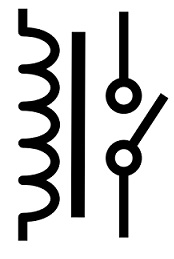
Resultado de imagen de relays symbolResultado de imagen de relays


martes, 4 de abril de 2017

5. EFFECTS OF ELECTRIC CURRENT


5.1. Heat.
The energy that an electric current produces as heat is called the Joule Effect.
It is expressed by the following formula:
                                                E = I^2 x R x t

5.2. Light.
Incandescent bulbs.
When an electric current passes through the metallic filament of a lightbulbs, it produces light. This phenomenon is called incandescence.

Fluorescent tubes.
Inside a fluorescent tube, there is a metallic filament, normally of tungsten. There is also an inert gas, such as argon, and a small amount of mercury.

Light-emitting diodes (LED)
A light-emitting diode (LED) has layers of semiconductor materials.

5.3. Electromagnetic effects.
In this experiment, the electric circuit has created a magnetic field. This effect can be used to produce movement.

5.4. Sound.
We can transform electric current into sound by using electromechanical devices, such as bells and buzzers. Some of these devices are based on the piezoelectric effect.

martes, 28 de marzo de 2017

4. TYPES OF CURRENT


4.1. Direct current.
Between the terminals of a battery, there is a continuous, stable flow of energy. If we use a voltmeter to measure the current in a car battery, the result will always be 12 volts. This is called direct current.

4.2. Alternating current.
If we measured the voltage of an electrical socket, the results could be represented in a graph like the one below:
  • The current begins at 0 V and increases to 325 V.
  • The current decreases from 325 V to 0 V.
  • The current becomes negative and decreases to -325 V.
  • The current increases to 0 V.
The variation of any electrical parameter over a period of time is an electric signal.
The tension or voltage of domestic electricity is an alternating signal because it alternates between positive and negative values. Its waveform is also sinusoidal, with a smooth, regular shape.

4.3. The efficiency of alternating current.
The average power of alternating current is equal to the direct current that is needed to produce the same effect. In the case of an alternating sinusoidal current, the average power would be as follows:
                                                            Vef = Vmax/√2
4.4. Transformers.
Transformers consist of two windings made of copper wire. If we apply an alternating current to one of them, it will produce a certain voltage in the other. The value will depend on the number of times that the copper wire has been wrapped around each winding, represented as n1 and n2:
                                                           V1/V2 = n1/n2

3. TYPES OF CIRCUITS


3.1. Series circuit.

Two or more elements form a series circuit when the output of one element provides the input for the next element.
To calculate the total resistance of a circuit, we add the resistance values of each load:
                                                      R = R1 + R2 + R3 +...
One example of this type of connection would be a series of generators.
In other words:                             V = V1 + V2 + V3 +...
 Resultado de imagen de series circuit

3.2. Parallel circuit.
If identical batteries are connected in parallel, the voltage of the circuit will not increase.
The equivalent resistance of this type of circuit would be:
                                                    1/R = 1/R1 + 1/R2 + 1/R3 +...
 Resultado de imagen de parallel circuit

3.3. Combination circuit.
A combination circuit has some elements connected in series and other elements connected in parallel.

lunes, 27 de marzo de 2017

2. ELECTRICAL QUANTITIES


2.1. Voltage or potential difference.
The amount of energy that a generator can transfer to electrons depends on its voltage (V) or electric tension. This is measured in volts (V).
This device has two wires that must be connected in parallel to the element that we are checking.

2.2. Measuring electric current.
Electric current is the charge or number of electrons that flo through the cross-section of a conductor every second.
                                                                  I= Q/t 
Electric current is measured in amperes or amps (A).

2.3. Electric resistance: Ohm's Law.
 The resistance (R) of a material is equal to the voltage divided by the intensity of the electric current which travels through the material. This ratio, which is called Ohm's Law, can be expressed as follows:
                                                                              R= V/I
Ohm's Law has two forms:
 V = R x I    and   I = V/R

2.4. Electric energy and power.

Electrical energy.
If an electric current flows at a particular tension for a certain amount of time, we can calculate the energy that is consumed:   E = Vx I x t
Is measured in joules (J).

Electrical power.
The electrical power of a load is the amount of energy that it can transform over a certain amount of time. Electric power is measured in watts (W) or kilowatts (kW).

If an electrical current flows at a particular tension, we can calculate the power (P) that is consumed:
                                                                        P = V x I
We simply multiply the power in kiloatts by the amount of time in hours.
                                                                        E = P x t

7. ELECTRIC CIRCUITS AND ELECTRONICS


1. AN ELECTRIC CIRCUIT.

An electric circuit is a pathway for the flow of electrons.
Electric current is a continuous flow of electrons through a circuit.

1.1. Parts of an electric circuit.
Electric circuits consist of various parts:
  • Generators provide the energy that electrons need in order to move.
 Resultado de imagen de cells and batteries
  • Loads are devices that transform electric energy into other types of energy that we can use.
 Resultado de imagen de light bulbs  Light bulbs
 Resultado de imagen de motors Motors

Resultado de imagen de resistors Resistors
 Resultado de imagen de electric bellsBells
  • Switching devices are used to direct and interrupt the flow of electric current.
 Resultado de imagen de switch symbol Switches
Resultado de imagen de push button symbol Push buttons
Resultado de imagen de way switches symbols3-Way switches


1.2. Diagrams and symbols.
Generators: electrochemical cell and battery.
Loads: Light bulb or lamp, resistor, motor, bell, relay.
Switching devices: switch, push button, 3-way switch.
Safety elements: fuse.
Measuring instruments: ammeter, voltmeter.
Other parts: connection and bridge.

lunes, 27 de febrero de 2017

8. HOW CAN WE SAVE ENERGY?


8. HOW CAN WE SAVE ENERGY?

There are two important ways we can save energy: by increasing the energy efficiency of the devices that we use and by recycling as much as possible.

8.1. Energy efficiency.

An energy-efficient device requires less energy to perform the same work.
  • Lighting: We can reduce the amount of electric light that we use by taking advantage of natural lighting.
  • Domestic appliances: New appliances have energy efficiency labels to indicate how much energy they consume.
  • Air conditioning and heating: We use a lot of energy to keep our homes at a comfortable temperature, but there are ways we can be more efficient.
  • Transport: The best way to consume less energy is to use public transport or to travel with other people when going long distances.
8.2.. Recycling.

Our consumption of manufactured products generates waste and uses energy. We can reduce these negative effects by recycling as much as possible.

8.3. Positive impact.

Energy efficiency has a beneficial effect on the environment.
There are various projects to develop clean energy, such as nuclear fusion, which is the source of our Sun's energy.